
 English
 Ελληνικά
 Selective laser trabeculoplasty (SLT) is a laser treatment used in the treatment of glaucoma. It is a minimally invasive procedure that aims to reduce intraocular pressure (IOP) by improving the drainage of fluid from the eye.
Who can undergo laser trabeculoplasty?
Patients with ocular hypertension as well as patients with early primary open-angle glaucoma can undergo laser trabeculoplasty as an alternative treatment to eye drops. Sometimes patients who are already receiving drops, can also undergo laser trabeculoplasty either because the drops do not regulate the intraocular pressure or to achieve a better result (lower intraocular pressure).
How does trabeculoplasty work?
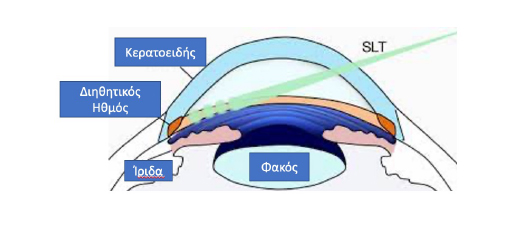
The drainage angle of the eye (or trabeculum) is located at the periphery of the iris and is the place where the aqueous humor is drained. The laser is aimed directly at the trabeculum to improve drainage of the aqueous humor. The laser uses short pulses of relatively low energy that target only the cells of the trabeculum that contain melanin without affecting the rest of the cells at all. This mild laser treatment results in the accumulation of leukocytes that “clean” the filter and help rebuild it to function effectively again and drain the aqueous humor, reducing intraocular pressure.
What are the benefits of treatment?
Trabeculoplasty effectively reduces intraocular pressure without side effects and without the need to use anti-glaucoma eye drops. It is particularly useful in the cases of patients who cannot apply eye drops correctly or who have allergic reactions. In addition, it can be used together with eye drops to optimize the control of intraocular pressure.
 How is trabeculoplasty performed?
Trabeculoplasty is performed in the doctor’s office or in a clinic that has the appropriate laser machine and does not require admission. Before the treatment, vision and eye pressure are checked, followed by a preparation of the eye with drops. The patient signs the consent to the treatment after first making sure that any questions and concerns have been answered by the doctor.
The procedure is very similar to the slit-lamp eye exam. Anesthetic eye drops are instilled and the patient places the jaw and forehead on a slit lamp that is connected to the laser. A special lens is then applied to the surface of the eye that allows us to see and target the drainage angle of the eye. During the treatment you may see flashes of light and hear the sound the machine makes with each laser pulse. Most patients tolerate the treatment well, very rarely a mild pain or burning sensation may occur. The process may take 10 to 15 minutes. After the end of the treatment you have to wait about an hour to recheck the intraocular pressure. We give you a prescription for a mild anti-inflammatory eye drops that you use for 5 days and we do a checkup 10 days to 2 weeks later. The final result for the reduction of intraocular pressure is assessed approximately 2 months after treatment.
What are the success rates?
Studies show a success rate of around 80% with most patients responding well to treatment but also with some patients not responding at all (not lowering intraocular pressure). Unfortunately there is no way to predict who will respond well and who will not.
If you are already taking anti-glaucoma eye drops you will usually need to continue them after treatment. The result of the treatment is judged approximately after 2 months and then we can decide whether or not to continue taking eye drops.
The effect of trabeculoplasty in reducing intraocular pressure weakens with time, but it can be repeated especially if the first time it regulated the pressure for a long time.
What are the possible complications?
Vision may be initially blurred but returns after a few hours. It is extremely rare for your vision to deteriorate after trabeculoplasty. If your vision remains blurry and you are concerned, you should contact your doctor immediately. It is good not to drive on the day of treatment.
It is possible that the pressure will increase immediately after treatment due to inflammation. To prevent this sudden increase in pressure, we use special drops before the treatment and administer anti-inflammatory drops or anti-glaucoma drops for a few days after the treatment.
In extremely rare cases, the pressure can rise to high levels and not go down despite taking drops or even medicines. In this case surgical treatment is necessary. This is a very rare complication that has been rarely reported in the literature.